Showing posts with label differentiated instruction. Show all posts

Friday, February 3, 2012

3-D Shapes

It's Friday! :)

We just wrapped up a fun week in geometry.  Students identified and described attributes of 3-dimensional shapes (i.e. vertices, faces, edges, bases).  Here are some of the things we did this week.
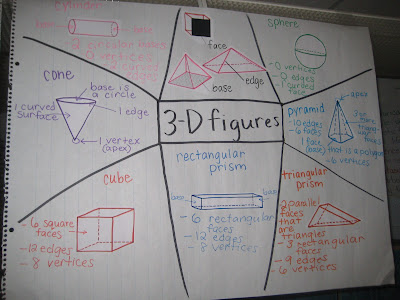
We created an anchor chart describing 3-D figures on Monday during a whole-class lesson.  At the same time, students filled out their flip books.  This is when we discussed vocabulary such as edges, bases, faces, and vertices.
   
During the week, students participated at the teacher station by
interacting with the Smart Board.  Students identified and counted vertices, edges, bases, and faces. 
  
Here is one of the flip books created during whole-class instruction on Monday.

Students pasted pictures of each 3-D figure in their book.  Then they wrote the attributes for each figure as we filled out our class anchor chart.


Before we filled out the rest of the flip book, we discussed and wrote down important vocabulary words and definitions on the back of our books.

During Independent station, students chose 2 or 3 shapes to compare and contrast using a Venn Diagram.  They referred to their flip books as necessary.


At the Game station, students created riddles for their partners to solve.  Students could use their flip books to describe shapes or to figure out the answer to the riddle. 


Here, a student in one of the high groups, completes a triple Venn diagram.  She refers to the shapes on her desk. 

Have a great weekend!

--Tabitha & Chloe

Tuesday, December 13, 2011

Getting Started

The back story to our blog...


After seeing success in book clubs in small grouping, we decided, "Why not try it in math?!" So we implemented a math workshop that focuses on one math skill a week.


So far we've seen...


Mastery of basic skills
Increased student engagement
Student excitement about learning math
More confidence in math competencies
Students taking ownership of the learning


... and of course---a whole lot of fun for us and the students!


Getting started...


When we first began brainstorming ideas for how to organize a math workshop, we knew that we had no idea what we were doing. :) Just like good writers look at mentor texts before writing, we researched what was working for other teachers.  We came across several great blogs and resources that we will mention throughout this blog.  We also found a few resources within our district for support.  We synthesized the materials to fit our teaching styles to support our philosophy of teaching and learning.  As with anything, it took a lot of trial and error, and--it still does!

Organizing our students...

After reading a wonderfully helpful blog by Beth Newingham, we decided to follow her suggestion for dividing our students into three groups: low, medium, and high.  To group our students, we give our students a weekly pre-test over the week's skill.  We then group the students according to their skill level. 

We also followed her rotation suggestion. 

Low Group:  Our low group starts out at the teacher station because they will need teacher instruction in order to be successful at the other stations.  They then move onto the independent station to apply the skill that they just learned and/or reviewed.  Lastly, they go to the game station for further practice on that specific skill or to review a previous skill.

Medium Group: Our medium group starts out at the game station.  Then they move to the teacher station and finish at the independent station.

High Group:  Our high group is often able to do the independent task before coming to the teachers station, so that is where they begin.  Then they rotate to the game station and end up at the teacher station. 

Differentiated Instruction in Math Workshop

Not only do we want to meet students at their level through small-group instruction, but we also tier the game and/or independent stations to best support their level of proficiency.  We try to keep the quality and the quantity of the activity/task the same.  However, the high group might solve more complex problems or take the learning more in depth.  Whereas, the low group will probably need more scaffolding by using manipulatives,
Organizing the Materials

Since groups are often completing different tasks for the game/independent station(s), we have to organize the materials so that each group receives the correct supplies without needing our assistance during transition.  We have designated specific areas of the room for each station's activities and materials.  For example, the game station materials will always be on the side table, and the independent practice materials are on the back counter.  At each place in the room, the materials are organized by group.  So far we have used folders with group names on them to organize the materials that groups will need during that station.

Math Workshop Schedule


Depending on the skill, we typically use this schedule for our math workshop instruction.  On Monday we give a pre-test over the week's skill.  We then teach a whole-class lesson.  We have found that most of the students need the background knowledge or a review of it to be successful at math workhop stations.  Tuesday through Friday lessons consist of a min-lesson, when we normally discuss the stations and the expected norms for each.  Then we spend 12-15 minutes at each rotation.  Finally, we wrap up our lesson with a closure. 

Transitioning between stations

When we first started workshop this year, the first few weeks were spent creating norms for each station.  One of the norms includes transitioning efficiently between stations.  To do this, we display a timer, either on the Smart Board or using Kagan's Jumbo Timer so that students know how much time is left in each station.  When the timer gets to 1:30 left in that station, students pick up their materials and quietly move to the next station.  We may earn a class marble for arriving at the next station, ready to learn by the timer gets to 0:00.  It's amazing to see the ownership the students take in watching the timer and moving on to the next station. 

The content at each station

Teacher station is spent at the Smart Board. 
To ensure equal participation and student engagement, students bring their slates and markers to the Smart Board.  All students work out problems on their slates.  Once all students give a thumbs up, signaling completion, the teacher may have students take turns writing an answer on the Smart Board.  This serves as ongoing assessment and promotes discussion.
Smart Exchange provides numerous resources for the Smart Board.  We start there when creating lessons for the teacher station.  Then we tweak our findings to best meet the needs of our students.
The teacher station looks similar for each group but also provides an opportunity for the teacher to modify instruction based on students' needs at the present time.  For example, the low group may need more practice with basic skills.  While, the high group may be able to solve more complex word problems.  When creating the Smart Board lessons, we try to include slides containing varying opportunities for practice.


The game station may sometimes include an exploration, where students work with a partner to problem solve.
During this game station, students work in partnerships to write down the perimeter of each shape.  To allow for smoother transitions, students were told which shape to start with.  Each pair started at a different shape.
Independent station normally consists of a tiered writing activity that reinforces the week's skill.  Once a week, the independent station also provides students with the opportunity to review learned skills through a review sheet or Math Box, as used in our Everyday Math curriculum.  On Fridays, we often have our students use writing to explain how they solved their problems.  We have found that by having students explain their work in writing, they demonstrate their understanding of the skill. 

Please share your comments and experiences with math workshop. We are continually seeking out ways to improve. 

Check back soon for posts with specific content ideas for math workshop.


--Chloe & Tabitha